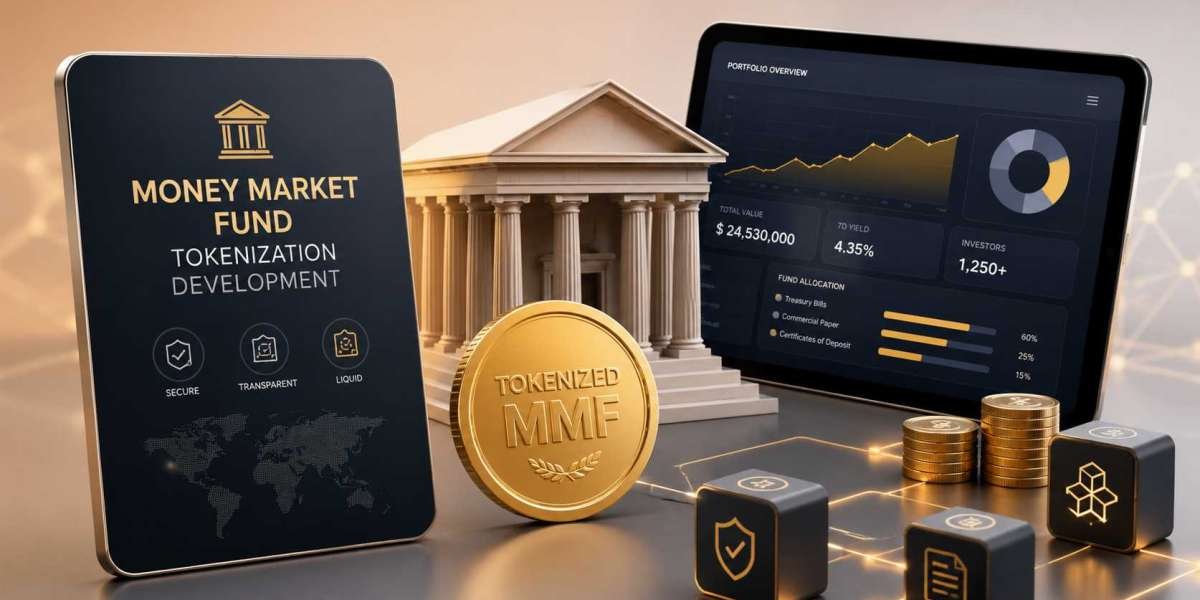

Money market funds (MMFs) have long been a preferred investment vehicle for businesses seeking liquidity, capital preservation, and short-term returns. They provide a secure way to manage excess cash by investing in high-quality, short-duration financial instruments such as Treasury bills, commercial paper, certificates of deposit, and repurchase agreements.
However, traditional money market fund operations often involve limited trading windows, settlement delays, multiple intermediaries, and manual administrative processes. As financial markets continue to digitize, money market fund tokenization development is emerging as a transformative solution that modernizes how businesses invest, manage liquidity, and access short-term financial products.
By converting fund shares into blockchain-based digital tokens, businesses gain faster settlement, enhanced transparency, programmable transactions, and broader accessibility. This evolution is reshaping corporate treasury management and creating new opportunities for enterprises worldwide.
What Is Money Market Fund Tokenization Development?
Money market fund tokenization development is the process of building blockchain-powered platforms that convert ownership units of money market funds into digital tokens. Each token represents a proportional interest in the underlying money market fund and provides investors with rights similar to traditional fund ownership, including:
- Ownership of fund units
- Income generated by the fund
- Redemption rights
- NAV-based value representation
- Regulated investor participation
Unlike traditional fund shares, tokenized units are managed through blockchain infrastructure, enabling automated transactions, real-time ownership records, and programmable financial operations.
How Money Market Fund Tokenization Works
The tokenization process begins when an asset management company creates or selects an existing money market fund.
The development platform then:
- Digitizes fund ownership into blockchain tokens
- Connects tokens with the underlying regulated fund
- Implements investor onboarding and KYC/AML verification
- Deploys smart contracts for fund operations
- Enables secure token issuance and redemption
- Supports compliant trading and transfer mechanisms
Smart contracts automate key functions such as subscriptions, redemptions, compliance checks, dividend distributions, and reporting, reducing operational complexity while improving efficiency.
Why Businesses Are Adopting Money Market Fund Tokenization
Businesses are increasingly seeking treasury solutions that provide liquidity, security, and operational efficiency.
Traditional treasury management often involves:
- Slow settlement cycles
- Limited operational flexibility
- Manual fund administration
- Geographic investment restrictions
- High operational costs
Money market fund tokenization addresses these challenges by introducing blockchain-based automation and digital ownership models. For enterprises managing significant cash reserves, tokenized money market funds offer a more agile and transparent approach to liquidity management.
Key Benefits of Money Market Fund Tokenization Development
1. Faster Settlement and Liquidity Access
Traditional money market fund transactions often follow T+1 or T+2 settlement cycles. Tokenized money market funds enable near real-time settlement, allowing businesses to access or deploy capital much faster. This improves liquidity management and enhances treasury flexibility.
2. Enhanced Corporate Treasury Management
Corporate treasury teams must continuously balance liquidity, operational expenses, and investment returns.
Tokenized money market funds enable treasurers to:
- Allocate idle cash more efficiently
- Monitor holdings in real time
- Automate investment workflows
- Redeem assets quickly when needed
This supports better working capital optimization.
3. Fractional Investment Capabilities
Traditional institutional investment products sometimes require large minimum investments. Tokenization allows fund ownership to be divided into smaller units, enabling greater flexibility in investment allocation. Businesses can optimize portfolio strategies without being constrained by large investment thresholds.
4. Increased Transparency
Blockchain technology provides immutable records of:
- Fund ownership
- Transactions
- Token issuance
- Redemptions
- Distribution history
Businesses gain greater visibility into treasury investments, improving governance and reporting.
5. Automated Compliance
Money market fund tokenization platforms can integrate automated compliance mechanisms including:
- Know Your Customer (KYC)
- Anti-Money Laundering (AML)
- Investor eligibility verification
- Jurisdictional restrictions
- Regulatory reporting
Smart contracts execute these rules automatically, reducing administrative burdens.
6. Lower Operational Costs
Traditional fund administration involves transfer agents, custodians, reconciliation teams, and multiple intermediaries.
Tokenization automates many operational processes, reducing:
- Administrative costs
- Settlement expenses
- Recordkeeping complexity
- Manual reconciliation
This creates more efficient fund management systems.
7. Programmable Financial Operations
One of the biggest advantages of tokenization is programmability.
Smart contracts can automate:
- Interest distribution
- Dividend payments
- Redemption processing
- Reinvestment strategies
- Treasury allocation rules
Businesses can build customized treasury workflows tailored to operational requirements.
8. Global Investment Accessibility
Tokenized money market funds can be made available to qualified investors across multiple jurisdictions, subject to regulatory requirements. This enables multinational businesses to manage liquidity across different regions through a unified digital investment infrastructure.
9. Improved Security and Record Management
Blockchain-based ownership records reduce the risk of data manipulation and provide secure transaction histories.
Businesses benefit from:
- Tamper-resistant ownership records
- Real-time transaction verification
- Enhanced audit capabilities
- Improved operational resilience
10. Integration with Digital Financial Ecosystems
Tokenized money market funds can integrate with broader financial technologies including:
- Digital asset custody platforms
- Enterprise treasury systems
- Decentralized finance (DeFi) infrastructure
- Tokenized payment networks
- Blockchain-based settlement systems
This expands the utility of corporate liquidity beyond traditional investment models.
Business Use Cases of Money Market Fund Tokenization
Money market fund tokenization can support a wide range of enterprise applications.
Corporate Treasury Optimization
Businesses can invest idle cash while maintaining rapid access to liquidity.
Institutional Cash Management
Asset managers and institutional investors can streamline short-term investment strategies.
Cross-Border Treasury Operations
Multinational companies can manage liquidity more efficiently across global markets.
Digital Banking Solutions
Financial institutions can integrate tokenized money market funds into digital banking platforms.
Blockchain-Based Settlement Networks
Tokenized funds can facilitate instant settlement within digital financial ecosystems.
Future of Money Market Fund Tokenization Development
The future of money market fund tokenization is closely connected to the broader evolution of digital capital markets.
Emerging innovations are expected to include:
- AI-powered treasury optimization
- Real-time blockchain settlement
- Central bank digital currency (CBDC) integration
- Tokenized collateral management
- Cross-chain fund interoperability
- Advanced smart contract automation
As regulatory clarity improves and institutional adoption accelerates, tokenized money market funds are expected to become a core component of modern treasury management and enterprise liquidity strategies.
Conclusion
Money market fund tokenization development is transforming how businesses manage liquidity, invest excess cash, and optimize treasury operations. By converting traditional fund units into blockchain based digital tokens, organizations gain faster settlement, greater transparency, programmable financial operations, and improved capital efficiency. Although regulatory and technological challenges remain, the long-term outlook is promising.